
Mali Day 3 - Djenne to Mopti
The town of Djenne (pron: Jenny) has been around for quite a while, and from walking around the place, it looks as if little has changed. Set on an island in a flat swampy inland delta of a tributary of the Niger, Djenne is one of the major draw cards for Mali - the UNESCO listed Djenne Mosque (info here and here) is apparently the largest mud brick structure in existence. It certainly looks impressive.

Some of the locals making mud bricks on the dry swamps outside Djenne with the Mosque dominating the skyline. In the wet season most of this low land is inundated.
 Children play in the sandy square out the front of the Mosque - once a week there's a large market here where traders can bring much needed supplies from out of town. Each stall is defined by four rocks where they'll set up their make-shift stalls (you can see a couple in the foreground) same family at the same place every week - nice and easy to remember
 Almost all the buildings in Djenne are built in the traditional mud brick style of the Sahel-Sudan. These fancy windows are one of the interesting influences received from thousands of years trading with Moroccans
 on the streets of Djenne....
Despite having no sewers or any drainage system, this place was amazingly clean
(much better than anything similar in our neck of the woods)
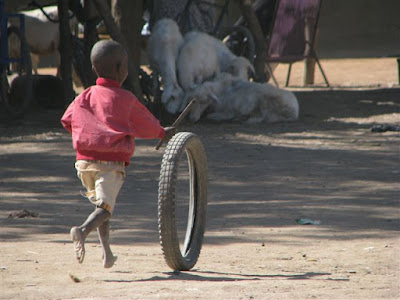 Most of the kids are usually in Koranic school during the day (like Timbuktu, Djenne is considered a centre of Islamic learning in Mali) - some kids just like to play.
 If you're going to market to sell your wares, you'll need to bring your own chair as well...
 or you could get your kids to do it for you....
 Millet is one of the staples around here and, unfortunately like most things in this part of the world, seems to take an inordinate amount of time and manpower to make it useful to people. In every town on the outskirts you'll see women pounding millet and using the breeze to filter the cracked husks from the goodness inside. The they have to grind it down to make flour.
 Just to make things a little more difficult. Pretty much all the vegetation surrounding these villages has been cut down for firewood - leaving nothing but arid land. Thus dung is dried and used as firewood by the villagers
 Children play in the sandy square out the front of the Mosque - once a week there's a large market here where traders can bring much needed supplies from out of town. Each stall is defined by four rocks where they'll set up their make-shift stalls (you can see a couple in the foreground) same family at the same place every week - nice and easy to remember
 Almost all the buildings in Djenne are built in the traditional mud brick style of the Sahel-Sudan. These fancy windows are one of the interesting influences received from thousands of years trading with Moroccans
 on the streets of Djenne....
Despite having no sewers or any drainage system, this place was amazingly clean
(much better than anything similar in our neck of the woods)
 Most of the kids are usually in Koranic school during the day (like Timbuktu, Djenne is considered a centre of Islamic learning in Mali) - some kids just like to play.
 If you're going to market to sell your wares, you'll need to bring your own chair as well...
 or you could get your kids to do it for you....
 Millet is one of the staples around here and, unfortunately like most things in this part of the world, seems to take an inordinate amount of time and manpower to make it useful to people. In every town on the outskirts you'll see women pounding millet and using the breeze to filter the cracked husks from the goodness inside. The they have to grind it down to make flour.
 Just to make things a little more difficult. Pretty much all the vegetation surrounding these villages has been cut down for firewood - leaving nothing but arid land. Thus dung is dried and used as firewood by the villagers
After walking around Djenne and some surrounding villages, we jumped back in the car and drove up to Mopti to begin the exciting part of our trip - a three day boat journey up the Niger River to Timbuktu !!
Mopti (info here) is a major trading post on The Niger (where the Bani - which goes down to Djenne - branches off) Here people board pinasses (small river boats) and pirogues (canoes), for either transportation or fishing.

Banks of the Niger - Mopti
 The bigger boats are so full of people and stuff that the driver has to sit at the front and steer via a fairly flimsy looking cable system to the rudder at the back (where another guy tinkers with an old diesel engine)
 The busy market-port of Mopti (mosque in the background) was quite amazing with the amount of stuff being moved. Salt from the mines north of Timbuktu is boated down and traded for various things. Fish are sold everywhere as are all manner of bits a pieces as usual...
 A lazy day in the pirouge


